
Tides and weather in the Ría de Arousa: what to know before your boat day
Tides in the Ría de Arousa move up to four metres of water twice a day, and the weather rules every plan: here's how we read wind, tide and swell before each departure from Vilanova de Arousa.
Every time someone writes to book a boat day, there's one question they almost never ask us — and one we always ask ourselves: what will the tide and the wind be doing that day? We rent out our skippered boat from the port of Vilanova de Arousa, and we check the forecast and the tide table before we check the calendar. Because in the Ría de Arousa no two days are alike: the same route can be a glide over glassy water or an uncomfortable rattle depending on the hour and the wind.
This article is the explanation we give on board, in writing: how the tides work here, which winds rule the Rías Baixas, and how we use all of it to make your outing the best possible version of itself. Spoiler: this is why the boat comes with a skipper — you don't need to know any of this, but it helps to understand why we sometimes suggest shifting the time or reordering the route.
Tides in the Ría de Arousa: four metres that change everything
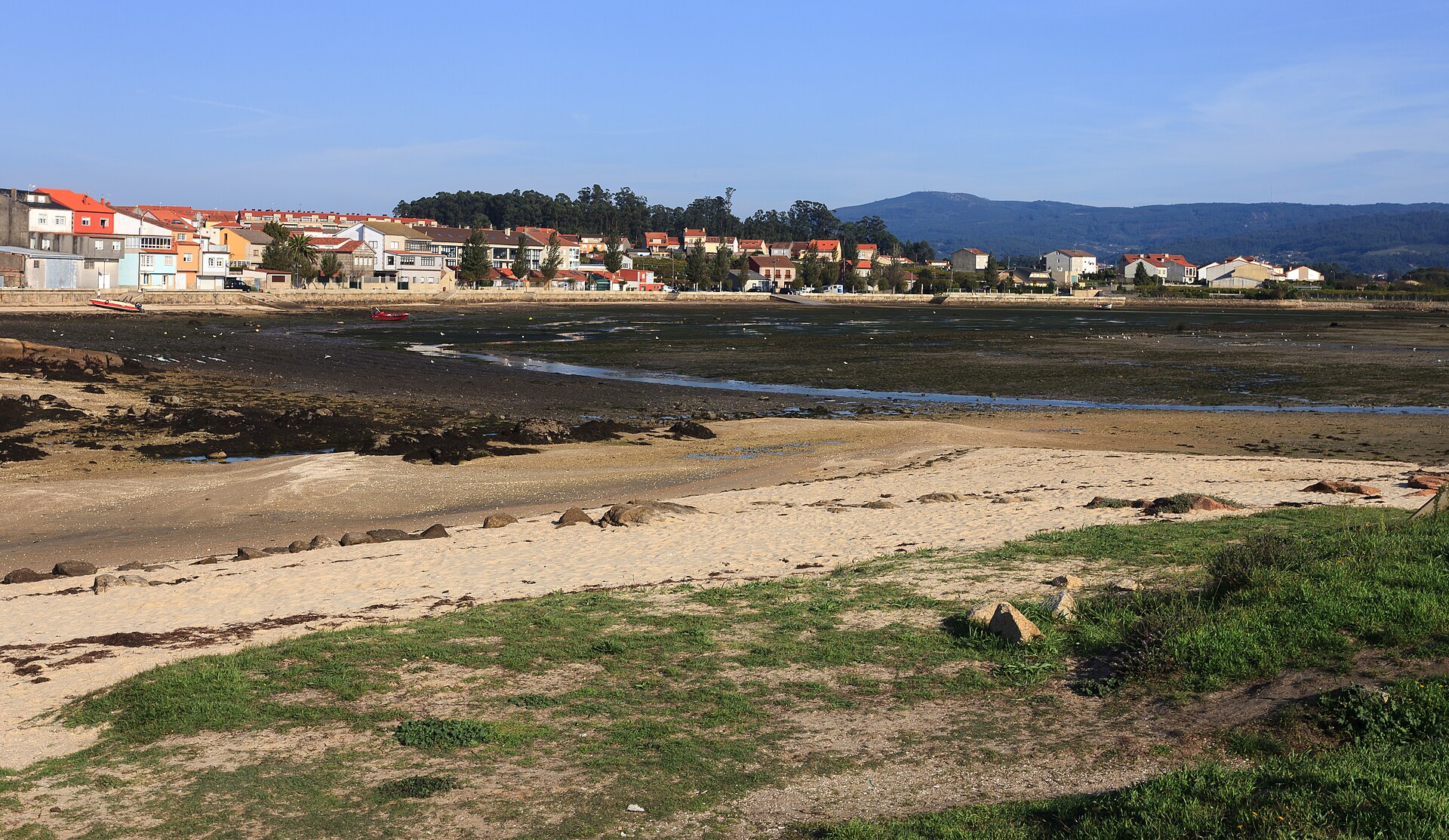
The Ría de Arousa is the largest of the Rías Baixas and has semidiurnal tides: two high waters and two low waters a day, roughly six and a quarter hours apart. The difference between high and low tide — the tidal range — runs from just over a metre on neap tides to nearly four metres on spring tides, the ones that follow full moon and new moon.
Four metres of water flowing in and out of the ría twice a day is no small detail. In practice, here's what changes:
- Beaches change size and character. The Areoso sandbank at low tide is a vast tongue of white sand where anchoring feels unreal; at high tide it shrinks to a strip. On beaches like Carreirón or Barraña, low tide uncovers hundreds of metres of sand.
- Anchorages are chosen with the tide table in hand. Anchoring with 3 metres under the keel at high water can mean touching sand four hours later. Our boat has a shallow draught, but every anchorage is still calculated against the tide.
- You feel the currents. In the narrow passes — between the Illa de Arousa and the mainland, near the bridge, or around Areoso — the tidal stream can top a knot and a half. With it, free speed; against it, extra fuel.
- Shellfishing shapes the scenery. At low tide you'll see the shellfish gatherers working the clam and cockle beds of O Carril and Vilanova. It's one of the most authentic sights of the ría, and it only exists at certain hours.
Spring tides and neap tides: when each one falls
Spring tides arrive a day or two after full moon and new moon: lots of water on the move, stronger currents, extreme low tides that uncover spectacular sandbanks. Neap tides, around the quarter moons, barely move water: everything is more stable and predictable.
Which is better for a boat day? Depends on the plan. To anchor off Areoso and marvel at the sandbank, a spring low tide at midday is a gift. For snorkelling with maximum visibility, we prefer neap tides or the hour of high water, when clean ocean water fills the ría. We'll tell you when you book: say what you want to do and we'll suggest the best window.
Wind in the Rías Baixas: nordés, southwesterlies and summer thermals
If the tide is the ría's clock, the wind is its mood. In the Rías Baixas there are three protagonists:
The nordés (NE): the fair-weather wind
The nordés is the wind of the Galician summer: it blows under high pressure, clear skies and great visibility. In the morning it's usually asleep, and from midday it wakes as a thermal breeze that can reach 15–20 knots by the afternoon. For us this is the typical July and August scenario: glassy mornings, ruffled afternoons.
How do we play it? Simple: the most exposed parts of the route — Areoso, the north face of the Illa de Arousa, the Punta Cabalo lighthouse — in the morning, and the afternoon in sheltered waters, hugging the coast of the Illa or towards Cambados, where the nordés barely reaches.
The southwesterly (SW): the one that brings the fronts
When the wind veers southwest, in Galicia we know what's coming: an Atlantic low, clouds and probably rain. It's the dominant wind of autumn and winter. With a strong southwesterly we simply don't go out — it's not worth it. The good news is that fronts can be seen coming days ahead, so if your booking lands on one, we'll talk and move the date. We'd rather reschedule than take you out to get cold and wet.
Thermals and the shelter of the ría
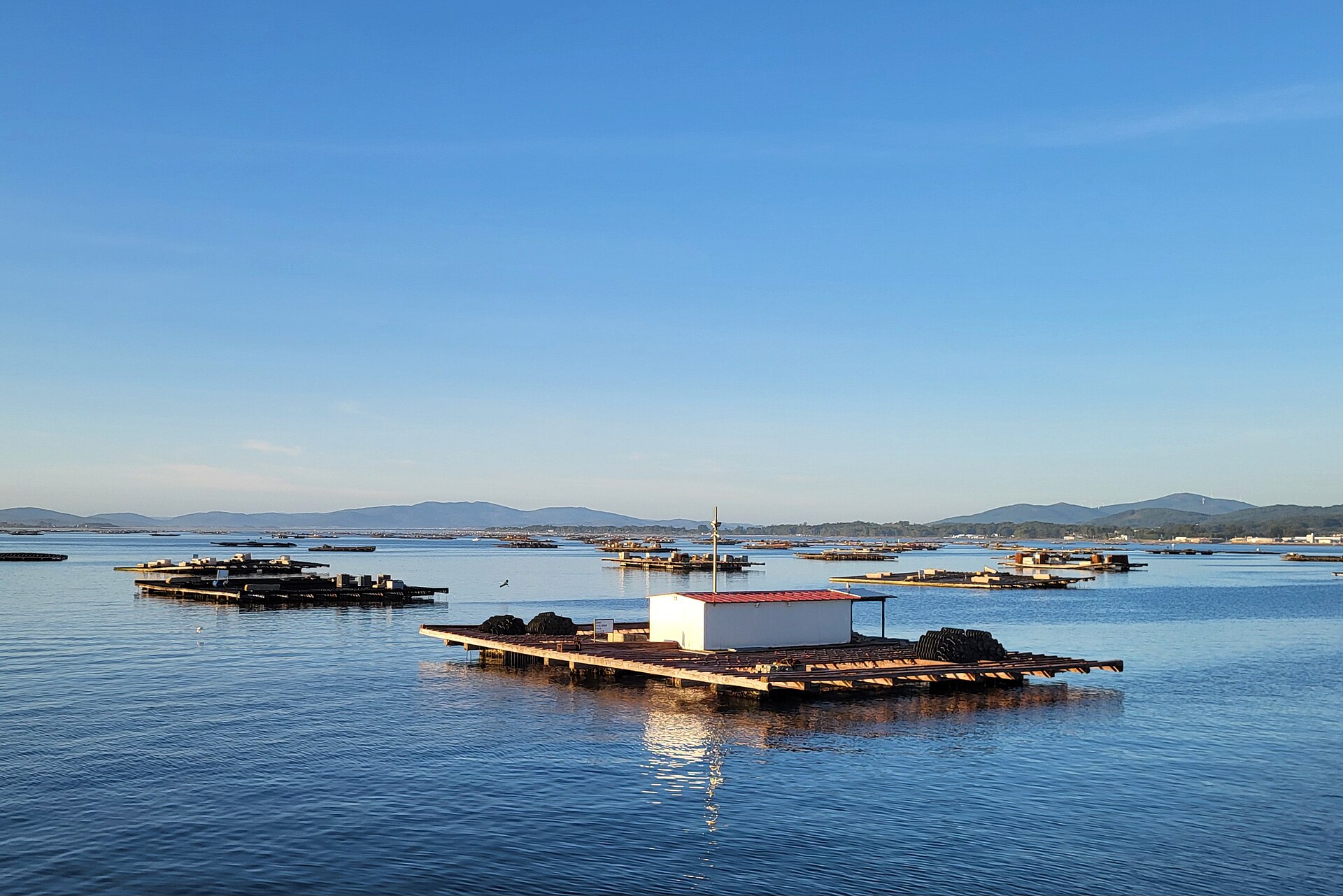
Here's the secret that makes the Ría de Arousa such a good place to sail: it's an inland sea. The Illa de Arousa, the O Grove peninsula and Sálvora island at the mouth cut off the Atlantic swell. Inside the ría there's almost never any groundswell; what you get is wind chop, which rises and settles with the breeze. That's why even on windy days we can almost always find a sheltered spot where the water is ironed flat. It's a matter of knowing the ría — and we've spent our whole lives on it.
How we check the forecast before your trip
We don't use one app: we use several, and cross-check them. Our routine before every departure:
- MeteoGalicia — the official Galician forecast, with high-resolution models for each ría. The reference.
- Windy or Windguru — to watch the wind hour by hour and compare models (ECMWF vs GFS). When models disagree, we get cautious.
- The tide table for the port of Vilagarcía — the nearest tidal reference to Vilanova. High water, low water and coefficient.
- Eyes on the ría — the advantage of living here: in the morning we see from the port how the water really looks, a data point no app provides.
With all of that we decide three things: whether we go out, at what time, and in what order we run the route. Most days from April to October the answer is "we go, and it's going to be glorious". When it isn't, we let you know in advance and find another date, no drama.
How does this affect your booking?
In practice, very little — and that's the point. House rules:
- You pick the day; we optimise the hour. If there's flexibility, we'll suggest the window with the best combination of tide and wind. A well-placed 4-hour half day beats a badly chosen full day.
- If the weather won't cooperate, we change the date at no cost. We don't go out in bad weather. The ría is to be enjoyed, not endured.
- The skipper adjusts the route as we go. The plan is yours (swimming, Areoso, mussel rafts, Cambados, sunset…), but the sea sets the order. Trust us: there's always a calm corner in Arousa.
- Rates don't change with the tide: half day (4 hours) €300, full day €500, fuel not included. Up to 6 guests plus the skipper.
Questions we always get
Do I need to know about tides to rent the boat? No. That's what we're on board for. This article is just curiosity well spent.
Do people get seasick in the ría? Rarely. With no groundswell, the motion is far gentler than on the open sea. If you're very prone to it, tell us and we'll plan a route through the most sheltered waters.
What's the best time of day? In summer, the morning: less wind, flatter water and fewer boats at the anchorages. The exception is the sunset trip, which has its own magic and usually coincides with the evening calm.
Can you go out in winter? Yes, choosing the day well. Between one low front and the next, Galicia serves up luminous winter days with the ría dead calm and not another boat in sight.
Book your day — we'll take care of the tide
If you want to spend a day on the Ría de Arousa without thinking about tidal coefficients or knots of wind, that is exactly our job. Message us on WhatsApp at +34 685 74 24 20, tell us what day you have in mind and what you'd like to do, and we'll tell you the best tide-and-wind window to make the most of it. We depart from the port of Vilanova de Arousa, up to 6 guests, with a local skipper who knows the ría by heart.
Photos: Chichole (CC BY-SA 4.0), Luis Miguel Bugallo Sánchez (CC BY-SA 4.0) and Urs Schönholzer (CC BY 4.0), via Wikimedia Commons.
Ready to experience the Arousa estuary onboard?
Full day €500 · half day €300 · fuel extra. Book on WhatsApp and we confirm in under 4 hours.
Book by WhatsApp

